From Broadway, With Love
During Stereophonic’s West End run, playwright David Adjmi joined host Douglas Schatz on The Play Podcast to unpack the decade-long making of his multi-Tony-Award-winning play.
In this edited extract from the conversation, Adjmi traces the work from its Led Zeppelin-inspired beginnings through to its unconventional form, and reveals the meticulous process of bringing its music, characters and fictional band to life.
DS: Stereophonic was 10 years in the making and is not a conventional play, nor is it a musical. So how did you come up with this mad idea?
DA: A lot of my plays are just these weird intuitions that crystallise over time and this was one of those. I knew that the idea for a play set in a music studio, using that setting as an apparatus to tell a theatrical story about a band making a record, would be interesting to me, but I didn't understand how I could make it dramatic because of the nature of that space. That was one of the challenges of it. I also knew that I really wanted to upend the tropes around these rock band stories, and I wanted to show the moments that people might want to excise from those stories; the kind of ordinary things that happen when you are in the midst of a process. I know about that because I'm in that process a lot as a playwright, so there's an analogue there. But it was really a long-form experiment and I let myself luxuriate and take the time that it needed for it to find itself.
DS: The kernel of the idea came to you when you were on a plane and heard a Led Zeppelin song. Is that right?
DA: Yes, I was on a plane listening to the in-flight radio and I heard Babe, I'm Gonna Leave You. There’s something about the nature of the song and vocals – how raw, incendiary and contradictory they are, clashing with the lyrical content… that contradiction and polarity really mesmerised me. When I heard it, I imagined [Robert Plant] in the studio and that's what made me go, "This could be a play."
DS: I'm interested in how you went about developing the songs and how they're connected to the play you're writing. They're written by Will Butler, but they feel very integrated.
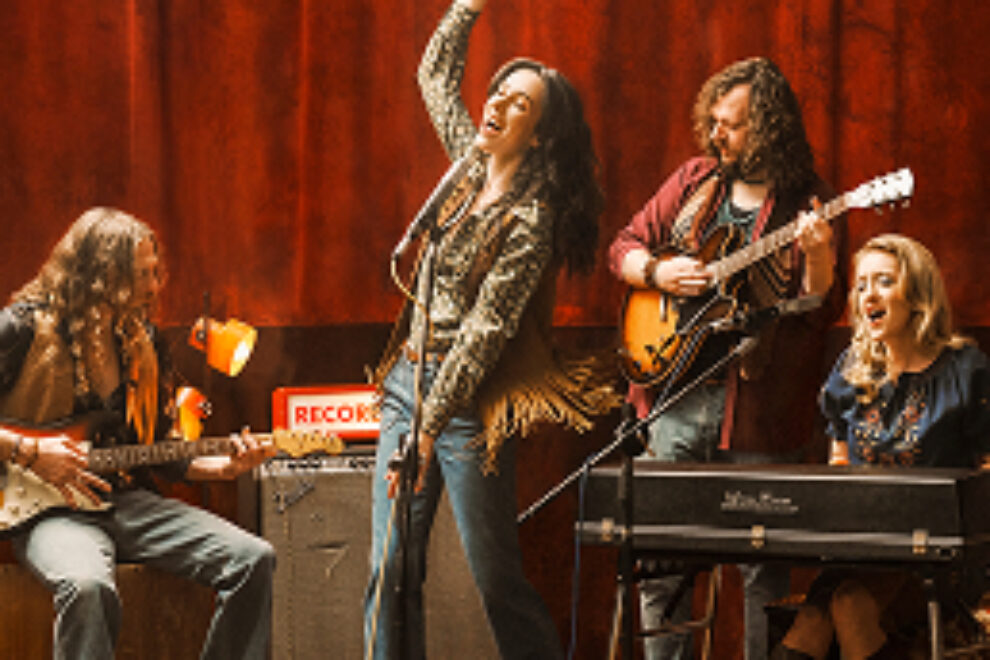
DA: It wasn't easy. I talk about it like doing a crossword puzzle, because you have to know 6-down to get 14-across, but you also need to know 14-across to get 6-down. These songs and the fragments of music that we hear are positioned in the play very strategically to help tell the story. I decided I would have these micro-plots for each of the songs. I knew I wanted the songs to recur in different iterations and in different arrangements over the course of the play; that it wasn't just about adding new songs in, but that we would be part of the process as audience members. Then, I conscripted Will to come in and look at what I made: “Here are these arguments about these songs that don't exist. You have to fill that in. You can do your thing and see if you can start to fill in the crossword puzzle.” Then we workshopped it and talked about it a lot: is this the tonality that we want here? Does it work dramatically in this scene based on where we are in the play? These were the conversations that we were having over the course of 18 months as Will refined it. It was a wonderfully collaborative process.
DS: It's mesmerising to watch them develop and perform the songs, and when they get it right, it's hugely exhilarating, as it must be for anyone who creates art.
DA: If the play works on you, you are invested in the process of them making this thing. If that's happening, then when they get it right, you're exhilarated with them. And that's what I want.
DS: There are these two engineers in the cast – obviously the band gets all the attention, but there is a really important purpose for the engineers structurally in our perspective, isn't there?
DA: The engineers are the aperture through which we see the band. So when the engineers are alone on stage, they have a different tonality. I am so in love with them as a pairing. They're such an odd couple, Charlie and Grover. They're the proxy for the audience; they're us watching this crazy band.
DS: The play takes place over a year in the studio and that's reflected in some way in the fact that it unwinds slowly. You're not afraid to let tedious, everyday things happen. I wondered at one stage – clearly this is deliberate – but there's a risk in reproducing the long years of this process in real time, so to speak.
DA: Well, I had thousands and thousands of pages. I did a lot of character studies. I knew I wanted it to be largely a character study and that I wanted people to fall in love with watching these sometimes-lunatic characters. I also knew I wanted to explore the intimacy that you can feel with people who are rockstars. But what's the obverse of that? What are they like when they're not blown-out and glamorous? What are they like when they're feeling insecure? What are they like when they're so slap happy and exhausted that they're almost not making sense? And so, how do I immerse people in this feeling so that we can get this very raw intimacy with these characters? I have never written a play like that before.
DS: What did you have in mind when you called the play Stereophonic?
DA: I really think that this play is about duality. There's a lot of doubling going on in the play, right down to the set: the control room where the engineers are and the band recording in the sound room. Often there are dialogue overlaps inside each of the spaces, so that is one of the bifurcations inside of the play. At the end of the play, Grover says to Diana, "Don't you think this was kind of a nightmare?" And she laughs about it and says, "No, this was the best thing that ever happened to me." I mean, it was a nightmare; it's both at the same time. That, to me, is the play. It's not that you have to suffer to make great art. It's not about the transaction. It's holding both in your mind at the same time. That is something I had to struggle to learn as an artist as I was writing the play. I think the play became a love letter to art, but also a message in a bottle to me to love the thing that was also driving me crazy, because it is really hard to do this art form and to keep at it for as long as I have.
This extract has been reproduced with permission.
Listen to the full interview on The Play Podcast below.